# CBSE Class 11–12 Computer Science & Informatics Practices
# Learn it. Practice it three real ways. Prove it on real papers.
> What does this print?
Class 11 Computer Science
18 real chapters-
01
Basic Computer Organisation
Introduction to Computer System · Types of Software · The Operating System (OS)
-
02
Boolean Logic and Algebra
The Foundation of Digital Logic · Basic Logic Gates (AND, OR, NOT) · Universal Gates (NAND & NOR) · Deriving OR from NAND · De Morgan's Laws · Boolean Logic
-
03
Number Systems
Introduction to Number Systems · Decimal To Binary Conversions · Octal & Hexadecimal Conversions · Encoding Schemes (ASCII, ISCII & Unicode)
-
04
Problem Solving & Algorithms
The Problem-Solving Cycle · Representing Algorithms (Flowcharts & Pseudocode)
-
05
Python Fundamentals
Introduction & Execution Modes · Python Tokens & Variables
-
06
Data Types & Operators
Data Types & Mutability · Arithmetic & Relational Operators · Logical, Assignment, Identity & Membership Operators · Expressions, Statements & Precedence · Input, Output & Type Conversion
-
07
Flow of Control & Errors
Introduction to Control Flow & Indentation · if Statement · if-else Statement · if-elif-else Ladder (Multi-Way Selection) · Nested if Statements
-
08
Iterative Statements
The while Loop · The for Loop & range() · Jump Statements (Break & Continue) · Nested Loops · Suggested Practical Programs
-
09
Strings in Python
Introduction & String Indexing · String Slicing · String Operations & Traversal · Built-in Methods (Case Conversion Methods) · Built-in Methods (Part-2) · Built-in Methods (Part-3)
-
10
Lists in Python
Introduction & Creating Lists · List Operations & Traversal · Adding & Modifying Elements · Deleting Elements · Built-in Functions & Sorting · Searching & Counting · Nested Lists & Suggested Programs · Lists - Quick Summary
-
11
Tuples in Python
Introduction, Creation & Accessing · Tuple Operations & Traversal · Built-in Functions & Methods · Tuple Assignment & Nested Tuples · Suggested Programs (Algorithmic Logic) · Tuples - Summary
-
12
Dictionary in Python
Introduction & Creation of Dictionary · Accessing & Modifying Data · Dictionary Methods (Part 1) · Accessors & View Objects · Traversal & Advanced Methods · Dictionary Suggested Programs · Dictionaries - Summary
-
13
Python Modules
Introduction & Import Syntax · The math Module · The random Module · The statistics Module · Modules - Summary
-
15
Digital Footprints
What is a Digital Footprint? · Digital Society & Netiquette
-
16
Data Protection & IPR
Data Protection & IPR · Open Source Software & Licensing
-
17
Cyber Safety & Crime
Cyber Crimes · Malware (Viruses, Trojans, Adware) · Cyber Safety & The IT Act
-
18
Technology & Society
Built by real CBSE CS/IP teachers, with real board questions tagged by topic and AI-evaluated subjective answers. Covers Class 10 AI alongside Class 11 & 12 CS/IP — MCQ, Output, SQL and Python, all in one real place.
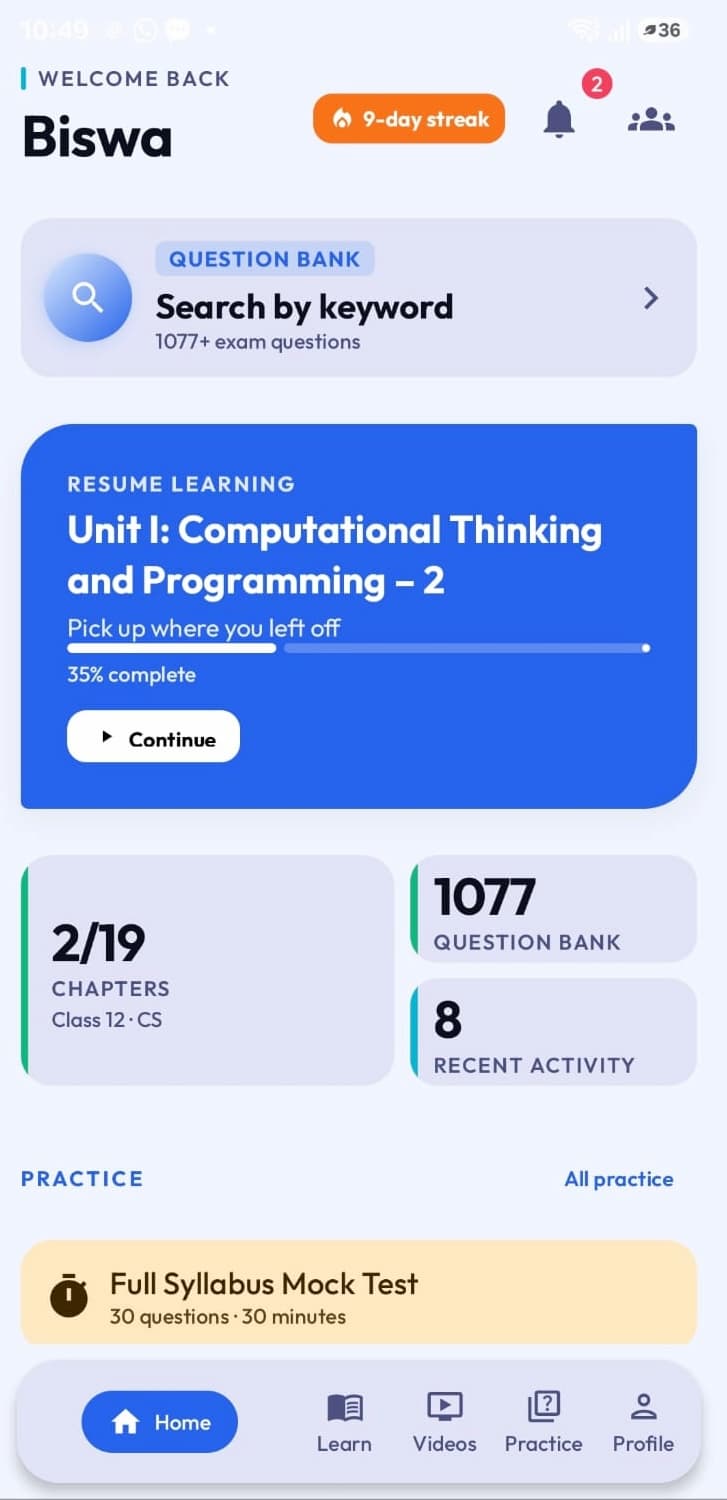
Also on Android
The same real KVCoders — learning, practice, and Live Challenges — continues on your phone.
- · Course progress carries over
- · MCQ & Output practice, on the go
- · Join Live Challenges from anywhere
Frequently Asked Questions
Is KV Coders free to use?
Yes. Lessons, videos, and practice tools (MCQs, Output Questions, SQL Arena, Python IDE) are open to everyone. Registering unlocks progress tracking and full PYQ Search.
Does KV Coders cover CBSE Class 10 AI?
Yes, alongside Class 11 and Class 12 Computer Science and Informatics Practices.
Are the questions real CBSE board papers?
Yes. PYQ Search is built from real Board, Sample, and Pre-Board papers, tagged by exact topic.
Do I need to register to start learning?
No. Lessons, videos, notes, and practice tools are open without an account. Registration is only needed for full PYQ Search and progress tracking.
Is there a Python IDE and SQL practice included?
Yes -- a built-in Python editor and a full SQL Arena are both free to use, no registration required.
What you get when you register
Guest access lets you try every tool. An account unlocks the guidance built around them.